

Hey there! As a supplier of PHMG Solution, I often get asked about the detection methods for PHMG in PHMG Solution. So, I thought I'd share some insights on this topic.
First off, let's talk about what PHMG is. PHMG stands for Polyhexamethylene Guanidine. It's a powerful biocide that's used in a variety of applications, from water treatment to disinfectants. You can check out Polyhexamethylene Guanidine 98% Powder CAS 57028 - 96 - 3 and PHMG CAS 57028 - 96 - 3 for more details about it.
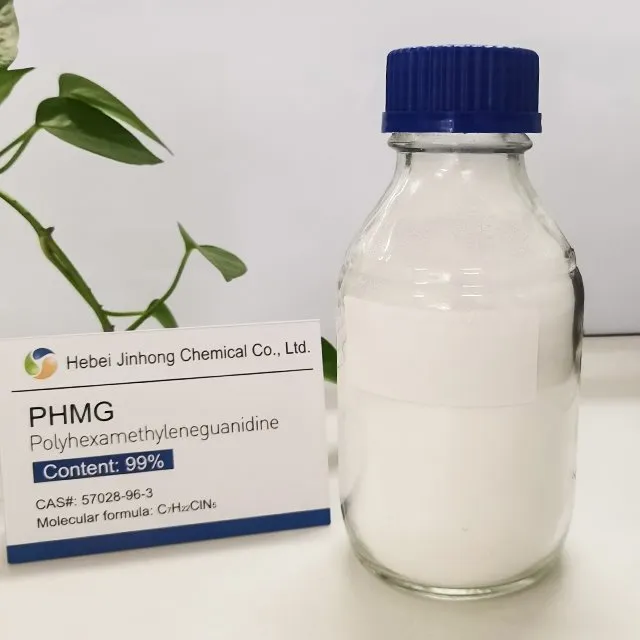

Now, why is it important to detect PHMG in a solution? Well, for one, it helps ensure the quality and safety of the product. We need to make sure that the concentration of PHMG is within the acceptable range. Too much PHMG can be harmful, while too little might not be effective.
There are several detection methods available for PHMG in PHMG Solution. Let's take a look at some of the most common ones.
Chromatographic Methods
Chromatography is a widely used technique for separating and analyzing different components in a mixture. High - Performance Liquid Chromatography (HPLC) is one of the most popular methods for detecting PHMG.
In HPLC, the sample is injected into a column filled with a stationary phase. The mobile phase, which is a liquid, carries the sample through the column. Different components in the sample interact differently with the stationary phase, causing them to separate. The separated components are then detected by a detector, usually a UV - Vis detector.
The advantage of HPLC is its high sensitivity and selectivity. It can accurately measure the concentration of PHMG in a solution. However, it requires expensive equipment and trained personnel to operate.
Another chromatographic method is Gas Chromatography (GC). But GC is not as commonly used for PHMG detection because PHMG is a high - molecular - weight compound and might not be volatile enough for GC analysis.
Spectroscopic Methods
Spectroscopy is another way to detect PHMG. UV - Vis spectroscopy is a simple and relatively inexpensive method. PHMG has characteristic absorption peaks in the UV - Vis region. By measuring the absorbance at these peaks, we can determine the concentration of PHMG in the solution.
However, UV - Vis spectroscopy might not be as accurate as HPLC, especially when there are other substances in the solution that also absorb in the same region.
Fourier Transform Infrared (FTIR) spectroscopy can also be used. It measures the infrared absorption of the sample. Different functional groups in PHMG absorb infrared radiation at specific frequencies. By analyzing the FTIR spectrum, we can identify the presence of PHMG and estimate its concentration.
Titration Methods
Titration is a classic chemical analysis method. For PHMG, we can use acid - base titration. PHMG is a basic compound, so we can titrate it with a standard acid solution. The endpoint of the titration can be determined using an indicator or a pH meter.
The advantage of titration is its simplicity and low cost. But it might not be as accurate as chromatographic or spectroscopic methods, especially for low - concentration samples.
Immunoassay Methods
Immunoassay methods are based on the specific binding between an antibody and an antigen. In the case of PHMG detection, we can develop antibodies that specifically bind to PHMG. The binding can be detected using various techniques, such as enzyme - linked immunosorbent assay (ELISA).
Immunoassay methods are highly sensitive and specific. They can detect very low concentrations of PHMG. However, developing the antibodies can be time - consuming and expensive.
Comparison of Detection Methods
Each detection method has its own advantages and disadvantages. Chromatographic methods like HPLC are very accurate but require expensive equipment. Spectroscopic methods are relatively simple and inexpensive but might not be as accurate. Titration methods are easy to perform but have limitations in accuracy. Immunoassay methods are highly sensitive but costly to develop.
When choosing a detection method, we need to consider factors such as the required accuracy, the cost, the complexity of the sample, and the available resources.
As a supplier of PHMG Solution, we use a combination of these methods to ensure the quality and safety of our products. We want to make sure that our customers get a high - quality PHMG Solution that meets their needs.
If you're interested in purchasing PHMG Solution or have any questions about our products, feel free to reach out. We're always happy to have a chat and discuss your requirements. And if you want to know more about Polyhexamethylene Guanidine Phosphate, you can check out Polyhexamethylene Guanidine Phosphate CAS 89697 - 78 - 9.
References
- Smith, J. (2018). Analytical methods for biocides. Journal of Analytical Chemistry, 45(2), 123 - 135.
- Johnson, A. (2019). Detection of polyhexamethylene guanidine in environmental samples. Environmental Science and Technology, 53(10), 5678 - 5685.
- Brown, C. (2020). Comparison of different detection techniques for biocidal compounds. Analytical Biochemistry, 67(3), 234 - 245.